

 4.8 ★★★★★ 3,000+ Google Reviews

Suffering a Nevada car accident is a harrowing experience, especially when it involves an airbag failure. Airbags can cause serious injuries when they malfunction, and victims can be left vulnerable and uncertain about their next steps in the aftermath.
The severe injuries that result from an airbag malfunction can form the basis of a product liability claim. Adam S. Kutner, Injury Attorneys, has represented people injured by defective products in Las Vegas for over 35 years. We aren’t afraid to take on powerful auto manufacturers and parts suppliers to fight for your rights.
Contact our legal team for a free case review with an airbag failure lawyer today.
START YOUR FREE CONSULTATION
NO FEES UNLESS WE WIN!
How Airbag Deployment Works and When They Should Trigger
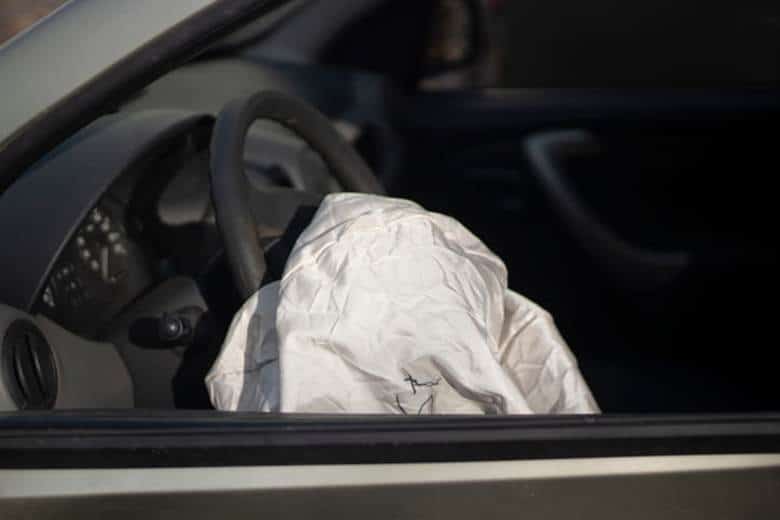
Airbag systems have a sensor that detects a triggering collision and sends a signal to a controller. The sensor is tuned to detect both the speed and direction of the crash to deploy at the right moment.
According to federal standards, frontal airbags must deploy at test speeds of 20 miles per hour (MPH). Front airbags can deploy in collisions around 14 to 18 MPH, but other airbags generally do not trigger in minor crashes because the risk of airbag injuries is outweighed by the relatively low risk of crash injuries.
When the controller initiates an inflator, the inflator causes a chemical reaction to produce a large volume of a harmless gas, such as nitrogen. This reaction occurs in just 0.03 seconds.
The airbag fills just in time to catch the vehicle’s occupant. However, airbags are not sealed because the body’s impact could rupture a closed bag. Instead, the airbag includes vents to release gas as the person’s head and chest strike it. The controlled deflation allows the airbag to cushion the body instead of impacting it.
Common Reasons Airbags Do Not Deploy in a Crash
Airbags are not designed to deploy in every crash. Some non-deployments occur due to a reasonable product design decision rather than a dangerous product failure.
The following design factors could cause a non-deployment:
- Crash location
- Crash angle
- Impact force
Airbags are designed to prevent certain types of injuries. Frontal airbags aim to protect vehicle occupants from striking the steering wheel or dashboard in a frontal collision. Curtain airbags help prevent vehicle occupants from striking the side windows, doors, or door posts in a side-impact crash.
As a result, the location, force, and angle of the impact can influence whether the airbag deploys. For example, an oblique frontal collision is less likely to trigger the frontal airbags than a direct collision.
However, non-deployments can also occur due to product defects in the design, manufacture, or warnings. Design defects are inherent in a product. An example of a design defect occurred in millions of Takata airbags, which used a novel chemical reaction that could cause an explosion in hot and humid conditions.
Manufacturing defects occur when the product is properly designed but improperly built. Faulty wiring or sensors would constitute a manufacturing defect.
Warning defects happen when manufacturers fail to explain how to use the product safely or warn against foreseeable misuse. For example, vehicle manufacturers are supposed to warn drivers to disable passenger airbags when children sit in the front seat. A missing warning may constitute a defect.
Call (702) 382-0000 For a Free Consultation
Signs Your Airbag Failed Due to a Defect
Perhaps the clearest sign your airbag is defective is if it fails to deploy in a crash that should’ve triggered it. A relatively direct impact to the front of your vehicle at more than 20 MPH should trigger the airbag, for example. A rear-end collision where you hit another vehicle from behind, a head-on collision, or a crash where you T-bone another vehicle should also typically trigger an airbag to deploy.
Another possible sign of a defect is a lighted airbag or supplemental restraint system (SRS) indicator on your dashboard. These warning lights tell you that the vehicle has detected a problem with your seat belt or airbag.
After a crash in a newer vehicle, an engineer can analyze the event data recorder (EDR). This recorder documents speed, steering angle, and braking before and during a crash. It may also capture faults in the signals sent to or received from the airbag system. This information can tell an engineer whether your airbags malfunctioned.
Immediate Steps To Take After an Airbag Failure in Nevada
After a crash, take the following actions to protect your health and legal rights:
- Seek prompt medical care and document your accident-related injuries.
- Call law enforcement to report your crash and ensure a police report is filed.
- Preserve the vehicle for further investigation by delaying any repairs.
- Document the vehicle’s condition, crash damage, and dashboard warning lights.
Finally, contact a lawyer to discuss your accident and your potential claim options.
Who Can Be Held Liable for a Defective Airbag in Nevada?
You may be entitled to seek injury compensation for a defective airbag, even if you caused the accident. Manufacturers are obligated to provide functioning airbags for all crashes.
The following parties may be liable when you suffer an injury due to a defective airbag:
- Auto manufacturer
- Parts maker or supplier
- Repair shop
A manufacturer is strictly liable for injuries caused by defective products. Thus, you can pursue compensation even if the company did not know about the defect, as long as the product was defective when it left the factory.
Repair shops may also be liable for negligence in any of the following areas:
- Troubleshooting an airbag warning light
- Alerting you to product recalls
- Replacing an airbag after a crash
An expert hired by your attorney for your product liability case can analyze the vehicle to determine who is liable.
Recovering Compensation for Your Airbag Injury Claim
An airbag injury can be devastating. Fortunately, you can pursue compensation for an airbag-related injury. The economic damages you receive can cover your medical costs, lost wages, diminished future earnings, and future care. Your non-economic damages can address pain, emotional trauma, and diminishment in your quality of life.
Automakers and their insurers may aggressively dispute liability claims because a loss could trigger an avalanche of claims from other victims. As a result, you must have an experienced personal injury attorney with the resolve to take on powerful corporations and insurers on your behalf.
Contact Our Las Vegas Car Accident Attorneys Today
Quick action is needed to preserve evidence, including the vehicle, EDR data, and the airbag unit. Investigating this evidence before it disappears or degrades is essential to any legal claim.
Our firm has decades of experience in auto defects and injury litigation. We have the resources necessary to stand up for crash victims against multinational corporations and their insurers.
Contact us for a free consultation to find out how we can help you fight for the compensation you deserve today.
Call (702) 382-0000 For a Free Consultation
FAQ
Call (702) 382-0000 For a Free Consultation
Areas We Service in Las Vegas, Nevada
Henderson | Anthem | Summerlin | Paradise | Summerlin North | Summerlin South | Sunrise Manor | Nellis AFB | Desert Shores | Downtown South | Charleston | Richfield | Crestwood | Angel Park Ranch | Queensridge | Casa Grande Pines | Winchester |

Adam S. Kutner
PERSONAL INJURY LAWYER
With more than 35 years of experience fighting for victims of personal injury in the Las Vegas Valley, attorney Adam S. Kutner knows his way around the Nevada court system and how to get clients their settlement promptly and trouble-free.